
The country
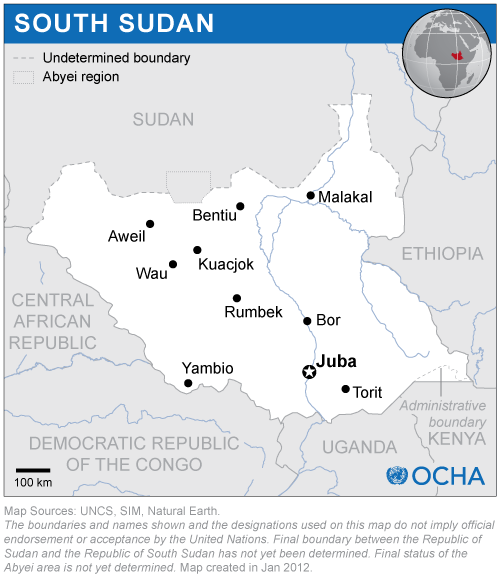
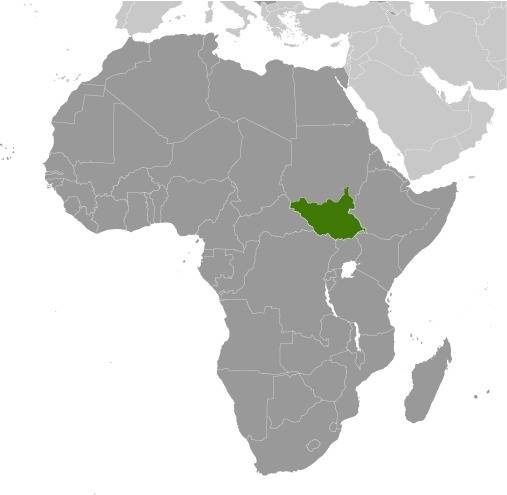
South Sudan gained independence from Sudan in 2011 and is the world’s newest independent nation. The country is located in East-Central Africa, bordering Sudan, Ethiopia, Kenya, Uganda, the Democratic Republic of the Congo and the Central African Republic. Its capital is Juba. South Sudan covers a land area of 644,329 square kilometers. As of 2026, the country has an estimated population of around 14.4 million people.
The humanitarian situation
South Sudan is in the midst of a dire humanitarian crisis driven by years of conflict, political instability and recurring violence. Although the 2018 peace agreement helped reduce large-scale fighting, violence has continued in parts of the country, and in 2026 South Sudan faces a serious risk of renewed nationwide conflict amid escalating political tensions and a worsening security situation. The crisis has left an estimated 9.9 million people in need of humanitarian assistance, while severe funding shortfalls are further exacerbating the situation.
At the same time, more than half of South Sudan's population is facing crisis or worse levels of hunger and in need of urgent humanitarian aid. Extensive flooding, intercommunal violence and disease outbreak continue to impact people across the country.
With some 4.5 million people forcibly displaced, South Sudan has the highest proportion - one third - of its population displaced of any country in Africa. More than 2.5 million people have fled to neighboring countries. Most of them are now in Uganda, which hosts 1 million South Sudanese refugees. About 2 million people are internally displaced. In addition, South Sudan hosts some 654,000 refugees and asylum-seekers.
In 2026, an estimated 9.9 million people - 69 percent of South Sudan's total population of 14.4 million - are requiring some form of humanitarian assistance. The humanitarian outlook remains alarming, with growing needs far outpacing the resources and capacity of aid agencies. Armed conflict, violence, disease, and natural disasters are devastating the lives and livelihoods of millions of people across the country.
The worsening humanitarian emergency in South Sudan is driven by the recent escalation of fighting between forces allied with the two main peace partners, subnational violence, spillover from the war in Sudan, disease outbreaks, an accelerating economic collapse, extreme weather events linked to climate change, and a sharp decline in international aid.
Since late February 2025, political instability and rising hostilities between armed groups have led to clashes, primarily in Upper Nile State but also in other regions. These clashes have devastated lives and damaged essential services. Already grappling with displacement, diseases, and food insecurity, many people have been forced to flee once more. The violence has swept through several states, escalating tensions nationwide with armed clashes and aerial bombardments causing widespread casualties.
The scale of the armed clashes is unprecedented since the 2017 cessation of hostilities, and civilians are bearing the brunt of human rights violations and forced displacement. The escalating crisis has forced thousands of South Sudanese to abandon their homes; In 2025, an estimated 300,000 people were forcibly displaced. Since the beginning of 2026, renewed fighting has forced over 530,000 people to flee, including around 110,000 to neighboring Ethiopia. Hostilities have continued to escalate, particularly in Jonglei, as well as in Upper Nile and Unity states.
Of the more than 4.5 million South Sudanese who have been displaced, neighboring countries are hosting over 2.5 million refugees. In 2025 alone, 148,000 people arrived in Sudan, 50,000 in Ethiopia, 50,000 in Uganda, 30,000 in the Democratic Republic of Congo, and 25,000 in Kenya.
South Sudan itself grapples with an internally displaced population of about 2 million. Women are disproportionately affected, bearing the greatest burdens and facing the greatest risks of displacement. The crisis has been further intensified by the influx of over 1.4 million returnees and refugees from Sudan since the war began in the neighboring country in April 2023. Over 70 percent of these new arrivals have settled in areas already experiencing extreme resource scarcity, placing extraordinary strain on limited supplies and services.
The sharp deterioration in the country's political and security situation since February 2025 threatens to undermine the peace progress made thus far and plunge the country back into war. Tensions have been heightened by internal conflict, particularly between forces loyal to President Salva Kiir and those aligned with Vice President Riek Machar.
According to humanitarian sources, aid agencies working in South Sudan are stretched to capacity as there is already not enough food, clean water, sanitation facilities, shelter, healthcare, or protection services in transit centers, existing displacement sites, refugee settlements and host communities into which vulnerable people from Sudan are arriving. Humanitarian organizations in South Sudan have called for urgent funding to ensure continued support for onward transportation for people fleeing the Sudan conflict to South Sudan.
Soaring rates of severe malnutrition, acute hunger, and deteriorating health conditions are threatening the lives and well-being of millions of people in South Sudan. The situation is exacerbated by extreme weather related to the climate crisis.
South Sudan is facing a major hunger crisis and is one of the world’s top five hunger hotspots. According to the latest Integrated Food Security Phase Classification (IPC) analysis, more than 7.8 million people in South Sudan — over half the population — are experiencing severe food insecurity, including 2.5 million facing emergency levels (IPC4) and 73,000 facing famine conditions (IPC5).
People classifiied in IPC5 are experiencing extreme food consumption gaps associated with starvation, heightened risk of death, and the collapse of livelihoods. The IPC analysis identified a risk of famine in Luakpiny/Nasir and Ulang in Upper Nile State, and Nyirol and Akobo in Jonglei State under a plausible worst-case scenario.
At the same time, over 2.2 million children under the age of five are experiencing acute malnutrition and require immediate nutritional services and treatment. Furthermore, an estimated 1.2 million pregnant and breastfeeding women in South Sudan are malnourished.
The deterioration in both food security and nutrition outcomes is driven by ongoing conflict and displacement. Humanitarian access remains constrained in several areas. Severe funding shortfalls that have reduced the availability of health and nutrition services and led to stockouts of critical supplies.
South Sudan is also one of the countries badly affected by climate change. Dry spell and flooding contribute to people’s food insecurity situation. Consecutive years of record flooding have led to widespread displacement, loss of farmland and destruction of livelihoods.
In 2025, flooding affected over 1.3 million people, displaced over 375,000, and resulted in widespread damage, with parts of Greater Upper Nile, Unity, and Jonglei States most affected. There has been widespread damage to homes, farmland, and critical infrastructure, further complicating humanitarian access. Schools and health facilities have been destroyed, resulting in the loss of essential supplies and preventing the resumption of education and health services. Crop fields have been inundated, devastating harvests. Meanwhile, livestock pasture has been washed away or remains waterlogged, further increasing food insecurity in affected areas.
Severe flooding also plagued the country in 2024, impacting approximately 1.4 million people in 44 of South Sudan's 78 counties and the Abyei Administrative Area. More than 379,000 people were displaced by the floods. Large swaths of the country were underwater year-round, and sudden flooding has hit new and unlikely areas.
Many of those hit hardest were people who had not yet recovered from the devastating floods between 2019 and 2022, which affected an average of over 1 million people annually. Prolonged flooding has made access to basic necessities, such as food, clean water, and healthcare, difficult and has contributed to the near collapse of livelihoods.
South Sudan is also home to numerous public health crises, exacerbated by limited immunisation coverage, disruptions in immunisation services, widespread displacement and the influx of displaced people from Sudan. Inadequate access to safe drinking water and sanitation, and natural disasters such as flooding, add to the vulnerability of communities.
The United Nations Office for the Coordination of Humanitarian Affairs (OCHA) has warned that millions of people in South Sudan are going without life-saving assistance unless additional funding for the humanitarian response is received without delay. Plummeting global funding exacerbates the already dire humanitarian situation by leaving people without essential aid and hindering aid agencies' ability to scale up emergency interventions, preposition supplies, and sustain operations
The humanitarian response in South Sudan suffers from severe underfunding. The 2026 Humanitarian Needs and Response Plan (HNRP) seeks US$1.46 billion to provide life-saving assistance to 4.3 million of the most vulnerable people - out of 9.9 million people in need. However, as of August 2026, the plan has only received $519 million—a mere 36 percent of what is needed.
The 2025 HNRP sought US$1.7 billion to provide life-saving assistance to 5.4 million of the most vulnerable people across the country - out of 9.3 million people in need. Despite growing needs, the HNRP was only 47 percent funded last year. Several life-saving programs had to be suspended due to a lack of resources in the context of the global humanitarian funding crisis.
According to the UN, 9 million people were in need of humanitarian assistance in 2024, a slight decrease compared to 2023. Among those requiring humanitarian aid were 4.9 million children. According to the UN Office for the Coordination of Humanitarian Affairs (OCHA), 9.4 million people - three quarters of the population - were in need of humanitarian aid or protection in 2023.
The humanitarian response in South Sudan required US$1.8 billion in 2024 to provide humanitarian aid to the 6 million people targeted. The 2024 Humanitarian Response Plan (HRP) was targeting only the most vulnerable children, women, and men, meaning the needs of millions of others remained unmet as humanitarian operations in South Sudan were severely underfunded. As of February 2025, the 2024 HRP was just 68 percent covered by funding.
In 2024, an estimated 4.6 million people in South Sudan, including women, girls, boys and men, were reached with some form of humanitarian assistance and protection. This is equivalent to almost 78 percent of the 5.9 million people targeted by the HRP for 2024. Of the total, 2.5 million were female and 2.1 million were male.
In 2024, the United Nations Refugee Agency (UNHCR) sought $1.4 billion to meet the needs of 2.3 million South Sudanese refugees living in five neighboring countries - Uganda, Sudan, Ethiopia, Kenya and the Democratic Republic of Congo (DRC), according to the Regional Refugee Response Plan (RRP). In 2024, only 27 percent of the required funding was received.
 The security situation
South Sudan has not held a presidential election since independence in 2011. After a power crisis erupted in 2013, South Sudan descended into conflict that has spread across much of the country, killing hundreds of thousands of people. A series of broken peace agreements and putative coalition governments have perpetuated competition between rival militias and a war economy that continues to fuel instability and violence.
An initial peace agreement signed in 2015 failed. After many delays, a revitalized agreement signed in 2018 led to the formation of a Transitional Government of National Unity in February 2020. Progress in implementing the peace agreement has been slow, however, as the parties quarrel over the division of power.
Elections had been postponed to December 2024 and the transition period had been extended until February 2025. In September 2024, the South Sudanese presidency postponed elections again and extended the country's transitional period by 24 months - until February 2027. The decision is seen as a collective failure by the country's leaders to create the conditions necessary to hold credible and peaceful elections.
The United Nations has endorsed the extension of the transitional period, albeit with regret and disappointment. The UN peacekeeping mission in South Sudan (UNMISS), the African Union (AU) and the Intergovernmental Authority on Development (IGAD) have called on all parties to break the perpetual cycle of successive transitions and to put the interests of South Sudan and its people first.
South Sudan is now scheduled to hold its long-delayed general elections in late 2026 or early 2027, but many question whether the world's youngest nation will be ready. In August 2026, the UN Commission on Human Rights in South Sudan, established by the UN Human Rights Council (HRC), warned that rushing toward elections without proper institutional safeguards or inclusive political dialogue risks plunging the country back into widespread conflict, noting that several warning indicators for atrocity crimes are actively converging.
Since February 2025, escalating hostilities in South Sudan have put the country’s fragile peace process at risk and further exacerbated the already dire human rights and humanitarian situation. Fighting between the South Sudan People's Defense Forces (SSPDF) and the Sudan People's Liberation Army - In Opposition (SPLA-IO), as well as their respective allied armed groups, has killed scores of civilians.
The latest violence erupted after a series of attacks and confrontations in February in Nasir County, Upper Nile State, reportedly involving a militia group called the White Army. Most of the fighting has been concentrated in Central Equatoria, Jonglei, Unity, and Upper Nile states.
Dozens of politicians linked to the SPLM-IO were arrested, including South Sudan's First Vice President Riek Machar; ministers; members of parliament; and military officers. In March, at least 55 senior government officials affiliated with the SPLM-IO were arrested across the country, including civilians.
Meanwhile, subnational violence within South Sudan continues to kill and injure civilians, impede humanitarian access throughout the country, and force people to flee from their homes. In addition to climate-related disasters, armed conflict and communal clashes are the main causes of displacement.
Escalating intercommunal violence in South Sudan's Warrap State has caused hundreds of deaths, destroyed homes, and led to widespread displacement since December 2024. Tonj East in Warrap State has witnessed a series of violent incidents, including cattle raids and retaliatory attacks involving large groups of armed youths from neighboring communities.
Armed violence and deteriorating security conditions exacerbate food insecurity and malnutrition rates, particularly among children under five and pregnant and lactating women. Ongoing fighting in neighboring Sudan and the increasing number of civilians crossing into into South Sudan have exacerbated the security and humanitarian situation in the country.
The UN Commission on Human Rights in South Sudan has said that South Sudan's political leaders must address the impunity and corruption that fuel gross human rights violations or risk jeopardising South Sudan's political transition.
Impunity for serious crimes fuels cyclical violence, conflict and gross human rights violations across South Sudan. Conflict-related and gender-based violence are widespread and unaddressed, causing severe trauma. Children across South Sudan face severe risks, including acute malnutrition, disruption of education, forced recruitment and other grave violations.
South Sudan remains at a heightened risk of renewed large-scale violence, with political tensions intensifying and ethnically targeted attacks spreading, particularly in Jonglei, Unity, Upper Nile and Central Equatoria states. There has also been a surge in human rights violations, including the forced recruitment of children by armed forces.
In February 2026, the Commission on Human Rights in South Sudan warned that political and military leaders were undermining the 2018 Revitalized Peace Agreement. This puts civilians at risk of renewed conflict, mass atrocity crimes and serious violations of human rights and humanitarian law.
South Sudan continues to be the one of the most violent context for aid workers in the world. According to the Aid Worker Security Database (AWSD), 16 humanitarian workers were killed in the country in 2025. At least 50 more were injured in attacks, and a further 24 were kidnapped.
The UN Office for the Coordination of Humanitarian Affairs says ongoing insecurity and violence against civilians and humanitarian workers affects the delivery of life-saving emergency supplies to people in an already dire situation. The work of humanitarian organizations is further hampered by access restrictions, bureaucratic obstacles, widespread crime, and inter-community violence.
Delivering humanitarian assistance to crisis-affected populations is particularly challenging in the country due to insecurity and the lack of basic infrastructure. Threats and attacks jeopardize the safety of aid workers and prevent relief organizations from reaching people in need. Criminal activities, such as ambushes and looting of humanitarian trucks and assets, often force temporary pauses in humanitarian operations.
Donations
Your donation for the South Sudan emergency can help United Nations agencies, international humanitarian non-governmental organizations (NGOs) and their local partners to rapidly provide water, food, medicine, shelter and other aid to the people who need it most.
- UN Crisis Relief: South Sudan Crisis
https://crisisrelief.un.org/south-sudan-crisis - World Food Programme: South Sudan emergency
https://www.wfp.org/emergencies/south-sudan-emergency - UNHCR: South Sudan emergency
https://www.unhcr.org/south-sudan-emergency.html - Oxfam International: Hunger crisis in South Sudan
https://www.oxfam.org/en/what-we-do/emergencies/hunger-crisis-south-sudan - International Committee of the Red Cross (ICRC): South Sudan
https://www.icrc.org/en/where-we-work/africa/south-sudan
To find other organizations to which you can donate, visit: Humanitarian Crisis Relief, Refugees and IDPs, Children in Need, Hunger and Food Insecurity, Medical Humanitarian Aid, Vulnerable Groups, Faith-Based Humanitarian Organizations, and Human Rights Organizations.
Further information
- UN OCHA: South Sudan
https://www.unocha.org/south-sudan - ACAPS: South Sudan
https://www.acaps.org/country/south-sudan/crisis/complex-crisis - Concern Worldwide: The South Sudan crisis explained
https://www.concernusa.org/story/south-sudan-crisis-explained/ - European Commission: European Civil Protection and Humanitarian Aid Operations: South Sudan
https://civil-protection-humanitarian-aid.ec.europa.eu/where/africa/south-sudan_en - Global Conflict Tracker: Civil War in South Sudan
https://www.cfr.org/global-conflict-tracker/conflict/civil-war-south-sudan - International Crisis Group (ICG): South Sudan
https://www.crisisgroup.org/africa/horn-africa/south-sudan - United Nations Mission in South Sudan (UNMISS)
https://unmiss.unmissions.org/ - Human Rights Watch: World Report 2026: South Sudan
https://www.hrw.org/world-report/2026/country-chapters/south-sudan - Human Rights Watch: World Report 2025: South Sudan
https://www.hrw.org/world-report/2025/country-chapters/south-sudan - Human Rights Watch: World Report 2024: South Sudan
https://www.hrw.org/world-report/2024/country-chapters/south-sudan - Amnesty International: Report 2025/2026: Human rights in South Sudan
https://www.amnesty.org/en/location/africa/east-africa-the-horn-and-great-lakes/south-sudan/report-south-sudan/
Last updated: 09/03/2026